- Home
- Membership
- Punching Nazis, borrowed brogues and an unusual sausage: 5 astonishing tales of WW2 survival
Punching Nazis, borrowed brogues and an unusual sausage: 5 astonishing tales of WW2 survival
As Italy descended into chaos in late 1943, thousands of Allied prisoners-of-war made a daring dash for freedom. But in their way stood crippling hunger, icy rivers and menacing SS soldiers. Karen Farrington tells five of the escapees’ stories
Published: November 29, 2026 at 3:30 PM
Save
- Share on facebook
- Share on twitter
- Share on whatsapp
- Email to a friend
By September 1943, Fascist dictator Benito Mussolini had been thrown in jail. A new government had signed an armistice with the Allies and Allied forces had invaded the Italian peninsula in the south.
Ad
Yet Mussolini’s race wasn’t run quite yet. Hitler was outraged at the Italian leader’s incarceration and hatched a plan to rescue him, pouring German troops into Italy from the north. And yet, for some of the 70,000 Allied PoWs dotted across Italy – held in more than 60 camps after being captured in fighting in north Africa – it presented an opportunity. They could make a bold bid for freedom.
Some were liberated when camp commandants opposed to the Nazis opened prison gates. Others dashed through hastily finished tunnels or flung themselves over high fences.
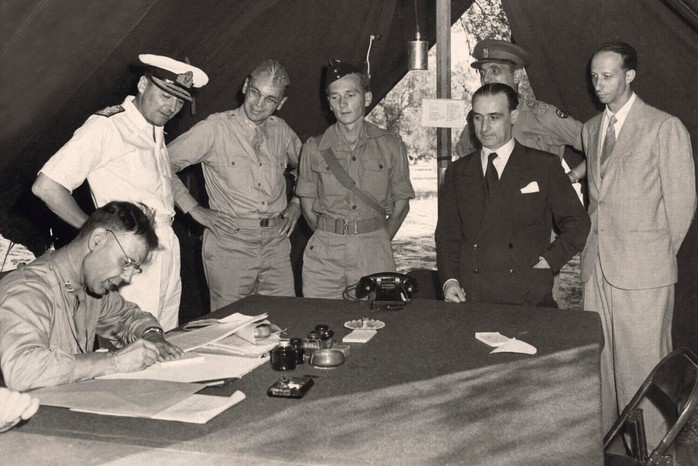
Diplomatic and military authorities sign the armistice between Italy and the Allied forces, September 1943. The turbulence of the time presented PoWs with an opportunity to escape | Credit: Getty Images
About 50,000 men took a chance, confident the Allied advance would be swift. They moved fast, hoping to rejoin the Allies but guessing the Germans would soon fill Italy’s power vacuum.
Within days Italy’s political landscape shifted again. The government fled into Allied-held territory. Mussolini was rescued by German forces and became leader once more, propped up by Hitler. German forces established a fortified front line across Italy, stretching from Termoli on the Adriatic coast to a point just south of Rome, to hold invading troops at bay. Suddenly, thousands of escaped Allied PoWs found themselves trapped behind enemy lines, desperate to locate escape routes. Many would be recaptured but 15,000 made it to freedom. Here are five of their stories…
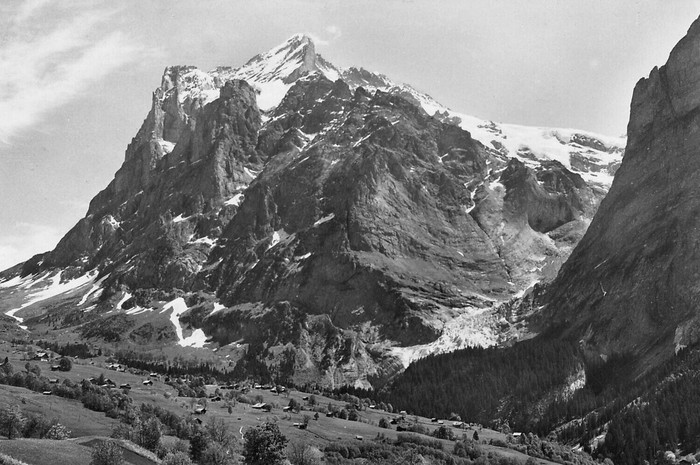
The Alps, pictured in 1936. Seven years later, Leslie ‘Nat’ Nathanson would traverse the mountains in a pair of borrowed brogues – an exhausting and painful journey that would save his life | Credit: Getty Images
1. The man who climbed the Alps in brogues
The cattle truck transporting Leslie ‘Nat’ Nathanson to a prison camp in Germany halted in a siding at Modena. Nat, 24, was incarcerated in Bologna when the armistice was announced. German soldiers had arrived a day later and now he was heading for a German camp.
Here was a chance for men to answer calls of nature – and attempt a dash to freedom. Nat brandished a toilet roll and headed for some bushes. As patrolling guards turned away, he leapt over a wall and pressed himself into stony ground by a railway hut. When he climbed through the hut’s open window, he found friendly railwaymen who escorted him arm in arm to the hub of the Modena escape network, based at a nearby sports centre. One of the network’s leaders, Joris Franciosi, found Nat and fellow escaper Terry Muirhead a single bed in a tiny flat in the city, belonging to the Italian’s sister, Maria, where they were to remain until they could be safely spirited away.
With Germans offering a cash reward for information about escapers, it was impossible to step outside. Windows remained shuttered so they could not be seen. This would be their hideout for six weeks until finally, a route through the Alps to Switzerland was agreed by the network.
First, there would be a rail trip to Milan, then another to the town of Domodossola, with Nat and another escapee disguised in overcoats and felt hats. They were travelling without identity cards and only narrowly escaped checks. Then came a seven-mile uphill bike ride to meet the guide. Sweating, the men wanted to ditch their heavy garments. But in November’s weather, the coats would be lifesavers.
When they set off with the guide, Nat struggled to keep up. Being cooped up in a prison camp and the flat had taken its toll and it was dark before they reached their mountain refuge. The next day, there was another nine-hour trek in tougher conditions. Nat’s heart hammered and his face burned with effort. Suddenly, a German soldier was spotted in the distance and they all ducked out of sight.
By now, Nat’s feet were pinching. He’d given up his robust British army boots – a tell-tale sign of an escaping soldier – and was wearing borrowed brogues, with the highest peaks still ahead. The Englishmen frequently tumbled into deep drifts or missed their footing in their thin-soled shoes. When they reached a hut the second night, they fell into an exhausted sleep. As Nat awoke, he could make out soldiers in grey uniforms huddled around a fire. Had men from the Wehrmacht captured them? In fact, Swiss guards had arrived to lead them to safety. Although others who risked the Alps crossing would perish in winter blizzards, Nat had conquered the mountains.
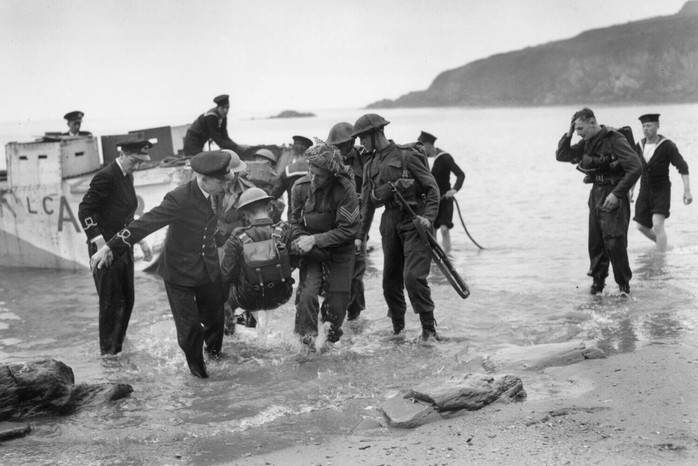
A wounded soldier is carried during training for rescue operations, 1943. For PoWs like Mick Wagner, waiting for rescue vessels was a nerve-wracking experience | Credit: Getty Images
2. ‘A’ force comes to the rescue
While Nat was being transported from Bologna, Major Mick Wagner was among a group crouched in the roof space of a camp hut, sweating as the sun scorched the tiles above and fearing bullets would be fired from below.
It was two days before he and his companions risked sneaking out, to spend several nights in a maize field. After one family gave food and clothes, Wagner, 25, and two other men set off for San Marino, a self-governing country inside Italy which hadn’t sided with Hitler. Here they were sheltered for weeks, until German troops were sighted. On they went, joining a band of partisans in the Apennine mountains.
Wagner still hoped to cross the front line to the south but needed somewhere to spend the winter. Once there, he heard about plans to ship hundreds of escaped prisoners to safety. In charge were men from ‘A’ force, a little-known uniformed army group responsible for helping escapees.
He also heard that men had turned up to designated rendezvous points, only to be fired at by German troops who lay in wait.
Finally, he decided to head east to risk his fortunes with ‘A’ Force. He and his friends had been directed to a town where Wagner was told to visit the butcher’s shop and ask for the proprietor by name. When the tradesman confirmed his identity, Wagner had been instructed to ask for a particularly unusual sausage. Only when he was informed a specific substitute was available, would he would know he was dealing with the right person.
From there, he and the others were led to an isolated farmhouse before being brought to a safehouse for his first encounter with Major Jock McKee from ‘A’ Force. The fearsome McKee was organising a seaborne evacuation for as many men as he could muster.
It was a nail-biting wait before the escape attempt was confirmed. Scores of escapees like Wagner left their billets with Italian families and crept to an estuary earmarked for embarkation. It was so quiet the men could hear German lorries thunder by and the occasional guttural voice.
The rescue vessel was expected at midnight. As daybreak approached, they were cramped from lying low and losing hope. Suddenly, the rumble of an engine could be heard offshore before the vessel beached and its doors opened. Armed marines flooded out to stand guard. Each escaper was assigned a group, and in turn they were ushered aboard. Within about 30 minutes the vessel was returning to southern Italy with 127 new passengers. On 25 May 1944, Operation Darlington II became the biggest ever single extraction of escaped prisoners.
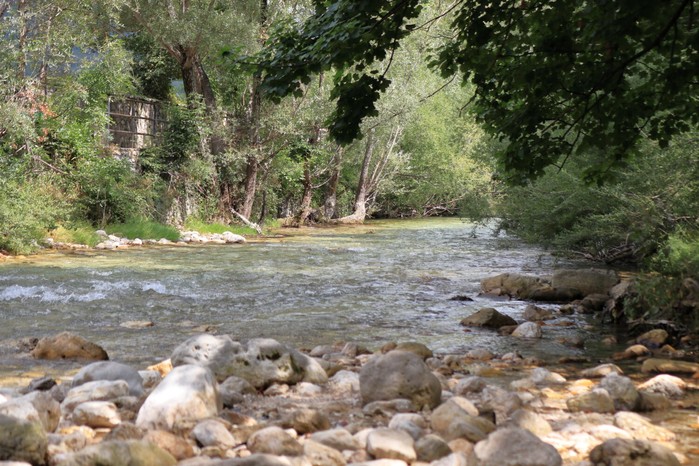
The river Sangro, which Sergeant Bill Cooper eventually crossed to get to safety after a long and perilous journey. His escape was almost foiled multiple times | Credit: Getty Images
3. Touching distance from disaster
With the rumble of artillery, then the rattle of small arms fire, Sergeant Bill Cooper knew he was approaching the front line. Twenty-five-year-old Cooper had walked south for several hundred miles after escaping a PoW camp in Italy’s Marche region. Now he was approaching Hitler’s fortified defences in November’s chill, having eaten the last of his food, and alert to minefields underfoot and reconnaissance aircraft overhead.
Travelling alone, he had met scores of helpful Italians. Here, there were none. Anyone living near Germany’s newly constructed front line had been forced out. Plagued by hunger, he found an abandoned vegetable patch with beetroot and tomatoes, then settled among the foliage under his blanket, hoping to sleep.
The approach of two hefty military vehicles ahead made him start. He slid across the ground, to see two more half-tracks behind him, both towing guns. They were joined by staff cars, lorries and even a field kitchen and Cooper’s patch of land was suddenly encircled by German soldiers and artillery. He knew the chances of being spotted in daylight were high. Silently, he wriggled out of his blanket and lay face down in the mud.
After sunrise, he could hear German radio operators and sentries being posted. Despite relentless rain, he could smell the breakfast being cooked for the men, oblivious of his presence. Only when darkness fell again did he risk raising his head and nibbling a beetroot, to stop his stomach rumbling. A soldier laying a telephone line passed within yards but failed to see Cooper’s prone body. For a second day, he lay inert but by that evening he could tell the range of the guns being fired had changed. Within minutes, they had packed up and withdrawn.
It took Cooper much longer to regain use of his cramped, cold limbs again. Creaking into an upright position, he renewed his quest. From a new vantage point, he saw the river Sangro and decided the enemy had gone. Just before dawn, he took off his boots and crossed the river – to come face to face with a Gurkha soldier, pointing a rifle at him. Cooper knew enough Urdu to explain himself. After two months of being hunted in occupied Italy, his journey was at an end.
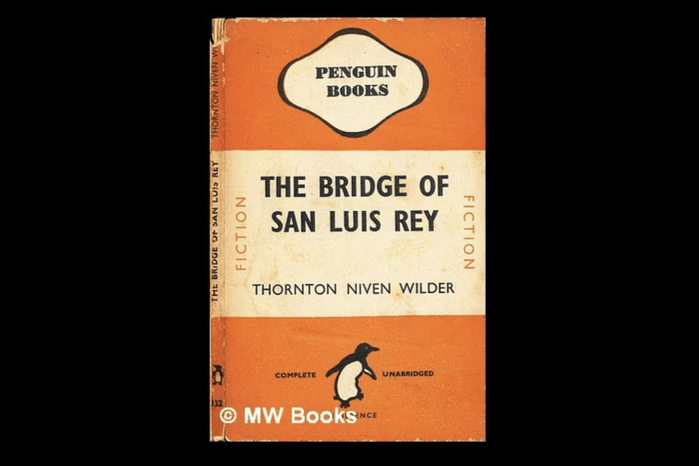
Amidst the horrors of escaping prisoner-of-war camps, boredom was rife. For John Verney, drawing and reading ‘The Bridge of San Luis Rey’ helped stave off the tedium
4. An icy swim to freedom
The armistice of September 1943 found John Verney in a prisoner camp locked down by a fascist commandant until Germans arrived. However, when Verney was being transported north, he and two others squeezed through a ventilation hatch in a stationary cattle wagon and fled.
The trio feared Italians would be hostile. However, they found families with little would share all they had. The men also knew anyone helping Allied soldiers on the run could be shot – and their homes burned – and it seemed a risk even to stay in farm outhouses. So Verney, 29, and his two friends climbed high into the Apennines, to become cave dwellers. In fact, they lived in two caves and were supplied by generous farmers.
Verney confessed later that boredom was his greatest enemy. He used firewood charcoal to draw a portrait of the wife he hadn’t seen for years. He read and re-read the one book they had, ‘The Bridge of San Luis Rey’. His hair grew long and his beard was matted.
As Hitler’s forces displaced more people to build better fortifications, Verney and his friends had to share the cave. After German soldiers approached one day, looking for farm animals to steal, the men abandoned the mountainside in an escape bid.
For the trek to the front line, they rubbed pork fat into ill-fitting boots they’d acquired and protected their legs with strips cut from an old coat. After splitting up, Verney was alone by the river Sangro at 3am, illuminated by a newly risen moon but confident he was close to freedom.
Carefully, he peered around a rock, and the flashes from two bullets split the night. Verney plunged into the icy river waters and let the dark currents take him past the German sentry unseen, with only his nose and eyes above water. When he clambered out the other side, he shivered uncontrollably but kept moving. At a nearby village, he wandered into a house where he found two British privates making breakfast. He would be home by Christmas.
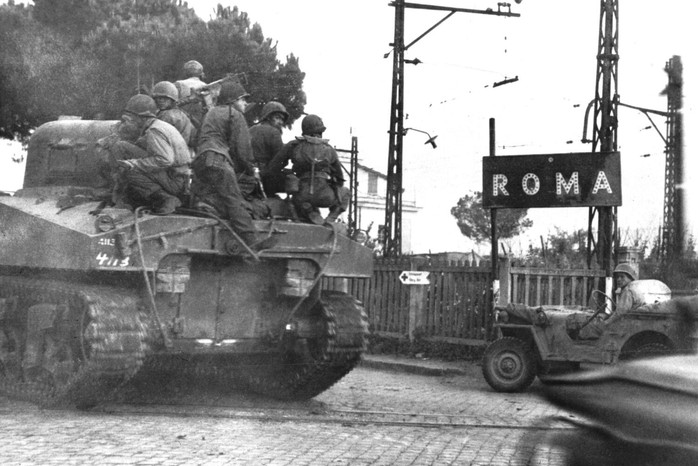
American troops enter Rome, 5 June 1944. Eric Garrad-Cole was living in the city when it was liberated, after escaping from a prisoner-of-war camp in 1943 | Credit: Getty Images
5. A punch in the eye for the SS
Pilot Eric ‘Garry’ Garrad-Cole repeated a simple Italian phrase to himself. If he could buy a train ticket to Rome, he would surely find sanctuary at the Vatican, still free from German control. A serial escaper even before the armistice, Garry, 26, had thrown himself from a moving train and received new clothes and cash from an escape network before heading to the railway station. He wasn’t gifted with languages but his “single a Roma” got him aboard.
In Rome, he walked purposefully towards St Peter’s Basilica where he accosted a priest. There was an anxious wait among well-dressed Italians and German soldiers before he was led to Rome’s deserted British embassy.
- Read more | The untold story of India’s WW2 prisoners of war
Hundreds of escapers had headed to the city or were living close by. Pope Pius XII was worried about provoking the Germans and refused them entry. The Vatican was already sheltering several hundred Jews and Russians. However, one churchman, Monsignor Hugh O’Flaherty, was working tirelessly to support escapers like Garry. The Monsignor and Major Sam Derry, another escaper, fed, financed and hid countless Allied ex-prisoners and Garry joined their organisation.
He moved around Rome with relative ease until one day he was challenged by two SS soldiers, who pocketed his fake identity card. Thinking fast, Garry tripped one and punched the second before dashing round a corner, as bullets whistled past his ear. By chance, he was in an area he knew well. He ran inside a building and hid behind a pillar until his pursuers ran past. The incident would spark a manhunt and there was no obvious hiding place. But Garry managed to haul himself on to the roof of the lift. As expected, soldiers swarmed the building. When the soldiers eventually withdrew, someone in the block swapped clothes with him. Then Garry, posing as a father, was led through a cordon to safety by the man’s 11-year-old son.
Afterwards, Garry left the city and changed his appearance, with a new hairstyle and a moustache. After the Allied landing at Anzio in January 1944, he tried – and failed – to cross the front line. However, he was back in Rome when it was liberated by the Allies on 4–5 June 1944.
Ad
Karen Farrington is a writer whose work focuses on social and military history. She is the author of The Great Italian Breakout: The Most Audacious Escapes of the Second World War (Icon Books, 2026)
Ad
Ad
Loading...
Ad
Loading...